





Driveway Gate Options for Georgia Homes: Swing vs. Slide vs. Automated
A driveway gate does three jobs at once: it adds security, it boosts curb appeal, and it gives you a real sense of privacy at the entrance to your property. But "I want a driveway gate" is really three decisions rolled into one — how it opens (swing or slide), what it's made of, and whether it's manual or automated. Here's how each option works and how to figure out which fits your driveway.
Swing gates: the classic choice
A swing gate opens inward or outward on hinges, either as a single panel or as a double gate that meets in the middle. It's the most common residential style for a reason — it looks traditional, it's typically the most affordable to install, and it pairs beautifully with masonry columns or matching fence panels.
The catch is space. A swing gate needs a clear arc to open into, which means a level area and enough room on the swing side. On a short or sloped driveway — common across hilly North Fulton lots — that arc can be a problem. A double-swing configuration cuts the required clearance roughly in half, which is why it's so popular on residential entrances.
Slide gates: better for tight or sloped lots
A slide gate rolls sideways across the opening instead of swinging, so it needs almost no clearance in front of or behind the gate. That makes it the go-to when the driveway slopes up from the street, when space is tight, or when a swing arc simply won't fit.
There are two main types. Roller (V-track) gates ride on a track set into the driveway — reliable, but the track needs to stay clear of debris and leaves. Cantilever gates hang from posts to the side and never touch the ground, which handles Georgia's rain, pine straw, and the occasional ice day more gracefully. Slide gates generally cost more than a comparable swing gate, but on the wrong lot they're the only option that works well.
Automated gates: convenience and security
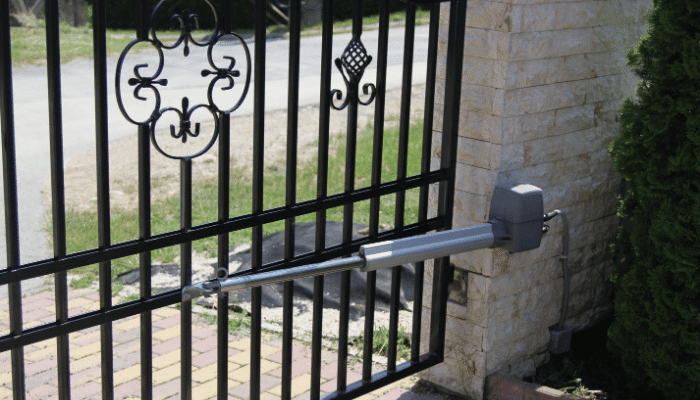
Automation isn't a separate gate style — it's an operator system you add to either a swing or slide gate so it opens with a remote, a keypad, a phone app, or a sensor. For many homeowners this is the whole point: you never leave the car, deliveries and guests get controlled access, and the entrance stays secure by default.
A proper automated setup includes the operator (motor), an access-control method, and safety sensors that stop or reverse the gate if something's in the path. You'll also need a power source at the gate; where running electrical is impractical, solar-assisted operators are an option. Automation adds meaningfully to the project cost, so it's worth deciding on it before installation — retrofitting later is possible but rarely as clean as building for it from the start.
| Feature | Swing Gate | Slide Gate | Automation (Add-On) |
|---|---|---|---|
| Best for | Level driveways with room to open | Tight or sloped lots, limited clearance | Any gate where convenience & access control matter |
| Space needed | Clear swing arc (double halves it) | Minimal front/back clearance | N/A — overlays swing or slide |
| Relative cost | Lowest | Moderate–higher | Adds to either style |
| Upkeep | Low; check hinges & latches | Keep track/rollers clear | Test sensors & battery backup periodically |
| Security level | Good | Good | Highest (controlled access) |
Choosing the right material for your gate
The gate should complement the fence and the home. Aluminum is the most popular residential pick — rust-resistant, lightweight enough for smooth automation, and available in the clean black estate look. Steel offers maximum strength and a heavier presence for larger or high-security entrances. Wood delivers warmth and full privacy but is heavier and needs more upkeep. If you want a true estate entrance, set the gate between brick and stone columns for a finished, permanent frame. Not sure which metal is right? Our breakdown of steel vs. aluminum fencing applies to gates too.
Georgia-specific things to plan for
Driveway grade is the first thing to assess — a slope often steers you straight toward a slide or cantilever gate. North Georgia's clay soil means gate posts need deep, properly set footings to carry the weight and stay plumb through wet-dry cycles, especially for automated gates where alignment is critical. And as with fencing, height and setback rules and HOA design approval vary by city across our service area, so confirm the requirements for your address before you build.
What it costs
Gate pricing depends on style, size, material, and whether you're automating. A single manual aluminum swing gate sits at the affordable end; a large automated slide gate with access control sits at the top. Because there are so many variables, a written on-site quote is the only accurate number — and Spectrum's price-match guarantee plus financing on qualifying purchases can make an automated entrance more attainable than expected.
The bottom line
Choose a swing gate for a level driveway with room to open, a slide or cantilever gate for tight or sloped lots, and add automation whenever convenience and controlled access are worth the investment. Match the material to your fence and home, and plan the posts and power for your conditions from day one.
Ready to design the right entrance? Spectrum Fence handles residential gate installation across North Fulton County — and for businesses, we also do commercial gate installation. Contact us or call 770-367-2925 for a free estimate, backed by our workmanship warranty.