





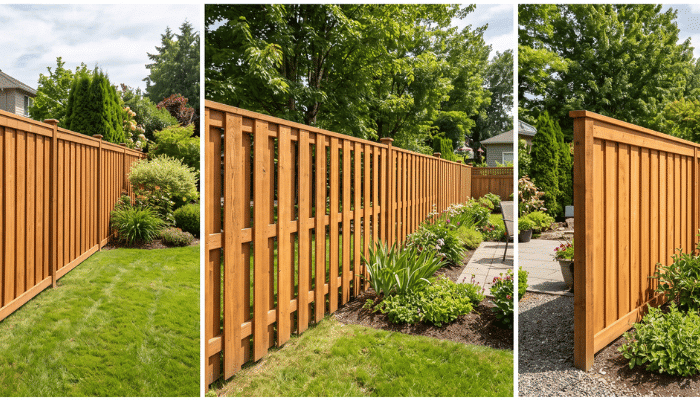
Privacy fencing isn't a one-size-fits-all decision. Board-on-board, shadowbox, and capped styles all deliver privacy and curb appeal, but they get there in different ways — and the differences matter once you factor in cost, maintenance, and how the fence will actually look from both sides of the property line.
Here's how the three compare.
Board-on-Board
Board-on-board fencing uses overlapping vertical boards with zero gaps, which makes it the most solid, fully private option of the three. Neither side can see through it, which makes it a popular choice for backyards that back up to a neighbor, a busy street, or a shared property line where privacy is the top priority.
- Privacy: Highest — no visibility through the fence from either side.
- Maintenance: Moderate. Because the boards overlap, there's more wood surface exposed to weather, so staining and sealing on a regular schedule (see our staining guide for a Georgia-specific timeline) matters more here than with other styles.
- Cost: Mid-range, since it uses more lumber than a single-layer design.
Shadowbox
Shadowbox fencing alternates boards on either side of the rail, leaving small gaps between them. From a distance it reads as a solid privacy fence, but up close there's a subtle "peek-through" — and because air moves through it, it holds up better against wind load than a fully solid fence. It's also considered more neighbor-friendly, since the alternating pattern looks identical from both sides of the fence rather than presenting a "finished" side and a "structural" side.
- Privacy: Good, but not total — there's some visibility at close range.
- Maintenance: Similar to board-on-board, though slightly less wood surface to treat.
- Cost: Comparable to board-on-board, sometimes slightly less depending on board spacing.
We covered this comparison in more depth in an earlier post if you want the full breakdown: Shadowbox vs. Board-on-Board Fences.
Capped Privacy Fence
A capped fence adds a horizontal cap rail across the top of a board-on-board or shadowbox-style fence, which does more than just look finished — it protects the top edge of every board from moisture intrusion, which is one of the most common places wood fencing starts to rot. For homeowners who want the privacy of board-on-board with meaningfully less long-term upkeep, capping is worth the upgrade.
- Privacy: Highest, same as board-on-board.
- Maintenance: Lowest of the three, thanks to the added moisture protection at the top rail.
- Cost: Slightly higher upfront, but often pays for itself in reduced repair and refinishing costs over time.
For the full rundown on why this style holds up so well in our climate, see Why Choose a Capped Privacy Fence?
So which one is right for your yard?
If total privacy is the only priority and budget is tight, board-on-board gets the job done. If you want a neighbor-friendly look with slightly better wind resistance, shadowbox is worth a look. And if you'd rather spend a little more now to stain and repair less later, capping either style is the smartest long-term move.
Not sure which fits your property? Contact Spectrum Fence for a free estimate — we'll walk your property line with you and recommend the style that makes sense for your yard, your neighbors, and your budget. Ask us about financing options if you're comparing costs across styles.