





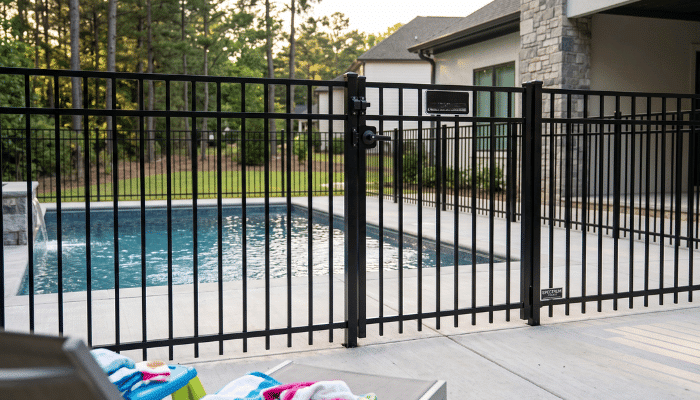
If you're installing a new pool — or just found out your existing pool enclosure doesn't pass inspection — you're probably wondering what Georgia actually requires when it comes to pool fencing. The short answer: any pool deeper than 24 inches needs a compliant barrier around it, and the rules are more specific than most homeowners expect. Here's what you need to know before you buy fencing or schedule an inspection.
The Basics: Georgia's Minimum Pool Fence Requirements
Georgia's residential pool barrier rules are based on the International Residential Code (IRC) and apply statewide, though individual counties and cities can require more:
- Minimum height: 48 inches (4 feet), measured from the ground to the top of the barrier on the side facing away from the pool.
- No gaps larger than 4 inches between vertical pickets or slats — small enough that a young child can't squeeze through.
- Ground clearance of no more than 4 inches under the fence (some counties tighten this to 2 inches).
- No climbable footholds. Horizontal rails can't be spaced in a way that turns them into a ladder — this is the rule that disqualifies a lot of standard aluminum fence panels from pool use.
- Chain link mesh must be 1¾ inches or smaller, or the fence needs privacy slats to meet code. Standard chain link fabric doesn't qualify on its own.
- Gates must be self-closing and self-latching, must swing outward away from the pool, and the latch release must sit at least 54 inches off the ground — well out of reach of small hands.
Your County May Require More Than the State Minimum
This is the part that catches homeowners off guard: several of the counties and cities we serve enforce stricter standards than Georgia's baseline.
- Fulton County (Atlanta, Roswell, Alpharetta, Sandy Springs, Johns Creek, Milton) applies tighter barrier standards than the state minimum, and pool permits are reviewed against those local rules — not just the IRC.
- Cobb County (Marietta and surrounding areas) generally requires a 5-foot minimum for residential pool enclosures, up from the 4-foot state minimum, and follows the 2018 International Swimming Pool and Spa Code.
Bottom line: don't assume a "code-compliant" fence from a big-box store or an out-of-town supplier meets your specific city's requirements. We build to the standard your local building department will actually inspect against.
Does the House Wall Count as Part of the Fence?
Georgia allows a home's exterior wall to serve as one side of a required pool barrier — but if you use it that way, any door leading from the house to the pool area must have a self-closing, self-latching device on the inside, and sliding glass doors typically need an alarm or a high-mounted latch to meet code. Most homeowners find it simpler (and safer) to fully enclose the pool on all four sides, separate from the house, rather than relying on door alarms that can be disabled or forgotten.
Which Fence Materials Work Best for Pool Enclosures?
Almost any material can be made pool-code-compliant, but some make it easier than others:
- Aluminum – The most popular pool fence choice. Rust-proof, low-maintenance, and available in code-compliant styles with closely spaced verticals and properly positioned rails.
- Vinyl – A solid, low-maintenance option that naturally meets spacing requirements and won't rot or rust around a wet pool deck.
- Chain link – The most budget-friendly route, but only when built with a tight enough mesh (or upgraded with privacy slats) to satisfy the 1¾-inch opening rule.
- Wood – Works well for pool enclosures when picket spacing and gate hardware are built to code from the start, and pairs nicely with a backyard that's already got a wood privacy fence.
Gates: The Detail Most Pool Fences Fail On
Inspectors flag gate hardware more than any other single item. Every gate into a pool area needs to:
- Swing away from the pool, never toward it
- Close and latch on its own — no propping it open "just for the party"
- Have its latch mounted high enough that a toddler can't reach it
If you're adding or replacing a gate as part of a pool project, it's worth pairing it with professional gate installation rather than retrofitting hardware onto an existing gate — self-closing hinges and latch height are much easier to get right the first time.
Building a Pool Fence in North Fulton County
We install pool-code-compliant fencing throughout North Fulton County — Alpharetta, Roswell, Milton, Johns Creek, Sandy Springs, and the surrounding area — and we build every pool enclosure to the standard your local building department will actually inspect against, not just the state minimum. That includes gate hardware, spacing, and height, whether you're enclosing a new inground pool or bringing an older enclosure up to current code.
Planning a pool fence or need an existing enclosure brought up to code? Contact Spectrum Fence or call 770-367-2925 for a free consultation — we'll help you choose a style that's both compliant and a good fit for your yard.
This article is intended as a general overview and is not a substitute for your local building department's requirements. Always confirm current code with your city or county before installation.